Our History.
A history of the neighborhood we love, as told by fellow neighbors.
-
Bues Family Recorded as First Owners
The recorded history of the Moonlight Bay property begins on April 15, 1884, when the United States Land Office sold government land surrounding Moonlight Bay to Carl Ernst Bues and Pauline Bues, his wife, along with Fred Hendricks. The purchase price was $3,200. The Bues family appears to have owned most of the land around Moonlight Bay, portions of which were sold or transferred to various individuals and companies over the following 85 years.
Bricks & Lumber Move In
In 1892, a portion of the property was sold to the Cream City Brick Company of Milwaukee. Founded in 1830, the company manufactured the light-colored bricks commonly known as “Cream City bricks.” These bricks were used extensively throughout Wisconsin and can still be seen in historic buildings around Door County.
Another portion of the land was granted in 1894 to the Leathem and Smith Lumber Company. The company operated a lumbering, manufacturing, and merchandising business and later expanded into stone quarrying. Part of its property eventually became the Leathem Smith Lodge in Sturgeon Bay. Remnants of an old logging road associated with the company remain within Moonlight Bay Estates.
During the early 1900s, ownership of the land passed through several individuals, financial institutions, and land companies. In 1912, Martin and Pauline Schram transferred the property to Ferdinand Holtz. The Holtz Land Company was incorporated in 1927, and in 1930 it sold property to Frank and Helen Urban. The transaction included a right-of-way along the old logging road, generally following the shoreline, to provide access to the property.
The Clubhouse is Built
Frank and Helen Urban built a log cabin on the shore of Moonlight Bay. Today, that cabin serves as the clubhouse for the Moonlight Bay Property Owners Association, although the precise date of its construction is unknown.
The Urbans continued to own the property for several decades. In 1961, they established an irrevocable trust with Kellogg Citizens National Bank of Green Bay to hold the Moonlight Bay real estate.
The neighborhood is sold and subdivided
On March 6, 1969, Kellogg Citizens National Bank, acting as trustee of the Frank Urban Trust, transferred the property to Moonlight Bay Estates, Inc. Developer John C. Brogan served as the company’s president.
Development began shortly thereafter. Sixty-one vacation and retirement home sites were created, gravel roads were completed, and the first lots were sold in June 1969. By September of that year, three model homes were under construction on Lots 34, 43, and 46.
A 1973 membership list shows that 38 lots had been sold. John VanDenWymelenberg, a Green Bay motel owner and business leader, purchased the remaining 23 lots from the original developer, John Brogan. The VanDenWymelenberg family also built the home adjacent to the clubhouse and lived there until 2002.
From its origins as wooded shoreline property used by early landowners, brick manufacturers, and lumber companies, Moonlight Bay gradually evolved into the residential community that exists today. Its historic logging road, shoreline cabin, clubhouse, and original development layout remain important connections to the property’s past.
-
By Shirley Raasch
Some of the Surviving Early Residents Include:
Bert Tucker (Cathy) — first house built; bought land in 12/1969
Pete & Barb Claussen
Iris Ebsch (Don)
Ruth Daniels (Richard)
George Cobb (Sharon)
Nancy Rafal (Harry)
Rita Scherpelz (Wally) & Rev. Robert Sullivan
Cheryl Sielen (Barney)
Mary McGinnis (Lyle)
Michel & Judy Roy
Elizabeth Lanzl (Dr. Lawrence)
Dennis & Dawn Klarkowski
Patrick & Karla Willms
David & Anne Marie Houston
David & Jill Haus
David & Bonita Koven
Carl Podlasek (Sandra)At one time there were several “round” houses with a keyhole design, including those of Rosberg, Bailey and Brennan. The homes were plagued by construction flaws, primarily issues with the roofs. There is presently only one remaining: the former Brennan home, now occupied by Dave Cross and Joan Fagan.
The early homes were built from a catalogue of plans for summer cottages, so insulation was not required. Building codes were almost nonexistent. Electric power was very cheap—so much so that it was sold to Commonwealth Edison in Illinois—so all homes were built with baseboard heat and electric ranges.
The primary builder of several of the early homes was “Big” Milt Hageman. Milt’s constructs shared similar flaws, including foundation sills subject to water intrusion, exterior stairs supported by a single concrete block, etc. There was a tree stump in the crawlspace of the Kramar house, and the septic consisted of a 55-gallon drum—one that was pretty rusted out when the Raasch family bought it in 2001.
Oh, and Milt killed his wife. Really. Details are known by some, but for the faint of heart will not be shared in this work.
Between Lots 46, 44 and 43 was the original logging trail, which extended to what was then “Old County Q.” Evidence of the trail continues through Lot 37.
Irene Zielinski petitioned on a regular basis for a tennis court to be provided at the clubhouse area. Never happened.
Perhaps because of her advanced years and inability to get around well, Irene was the only person in the subdivision with a rural-delivery mailbox. Karl and Joan Nystrom moved into the home previously owned by John VanDenWymelenberg. Karl, ever cautious with a dollar, petitioned the Baileys Harbor postmaster to extend delivery to all who wished to have it here and was successful in that endeavor.
Irene and her husband, Boleslaw, are reported to have fought with the Polish Resistance during World War II.
Anyone concerned that we have too many rules? Bill Kelly was known to be the self-appointed by-laws compliance enforcer, keeping tabs to ensure compliance. Bill drove around in his mule with Jim Stuppia and Ashley Sinnett.
Ash and Dee Sinnett originally lived in the home most commonly remembered as that of Nancy Rafal, now owned by Christina Studebaker. After their garage burned, they built a new one, unattached, and eventually moved across County Q next to George and Sharon Cobb.
It was due to this fire that some subsequent residents chose not to build attached garages. Ash and his brother Dave, along with many others including Dick Daniels and Wally Scherpelz, were the brains and brawn of clubhouse maintenance, rebuilding the porch and setting up the boat racks, which were built by Joe Biwer, not a resident.
Ron Beno, although not a resident, was a much-loved character. Ron had an auto repair shop off Sunset and Birch Roads and could fix anything. He had a wide assortment of parts available from the many junkers on his property and worked side by side with his wife, Vi.
The business ran on the honor system. When the time came to retrieve a vehicle, all one had to do was pick up the keys and leave whatever money was due on the counter. Ron had keys to almost every home in the subdivision at the time, so he could check on things while the seasonal residents were away.
Ron was a hunter—his deer stand was in the conservancy behind the Rosberg house—a fisher and a plower of driveways. Honesty and integrity personified, he was so loved.
Ron had many stories to tell. One time, he brought sardines to a bear den, crawled in a bit and saw six eyes looking at him. Ron always warned about the quicksand at Mud Lake. He had a terrifying experience when he became stuck in it once and was fortunate to have had his grandson with him to aid in his survival.
It is reported that one time a woman came to Ron’s shop because she was having trouble with her car and asked if he would look at it. While doing so, he noticed a man in the back seat, assumed to be her husband, and asked if she knew he was dead.
During a particularly nasty snowstorm resulting in considerable accumulation, Shirley Raasch called Ron, asking if he could plow their driveway. Karl had injured his back and was unable to operate their tractor and snowplow.
Ron had been working all day and into the night with his regular customers. Not knowing at the time of any other snowplowers, the Raasches were in a quandary, as Shirley was still commuting to Illinois for her job.
Late that night, out of the darkness came two bright lights attached to Ron’s huge John Deere front-end loader coming up the driveway. What a relief.
The next morning, Shirley called Ron, asking what they owed him.
“Nothing,” he said. “That’s what you do for your neighbors.”
That is the kind of person Ron was.
Ron was very ill for a long time from the effects of Agent Orange while serving in Vietnam. He died of liver cancer. A big part of Moonlight Bay Estates was lost with his passing.
Former Wisconsin State Committeeman Gary Bies, presently a Sister Bay resident, was once a local snowplower and deputy sheriff. He remembers all of the original property owners.
Bert and Cathy Tucker purchased their home, the first to be purchased, in 1969. One of the three “model” homes, it was not yet meant to be sold.
Don Ebsch could be heard playing the accordion on his porch, attracting and gathering neighbors and sharing the camaraderie. Don would also play at the association potluck dinners.
Flora Kramar worked as a secretary to the president of the Dry Ice Company, which also employed Taffy Kelly and Bert Tucker. It was Bert who introduced the Kellys and Kramars to Moonlight Bay.
Flora knew how to have a good time and organized many parties, many of which were spontaneous. Some were at her home or on the bay, accompanied by several residents who owned and moored their boats off the pier. It was the larger boats that had the moorings.
The Kramar home was also known for regular and very serious bridge games.
Flora was an interesting person in many ways. Not being the most traditional, she could be seen exercising her huge black Labrador dogs through the neighborhood alongside her Lincoln Town Car.
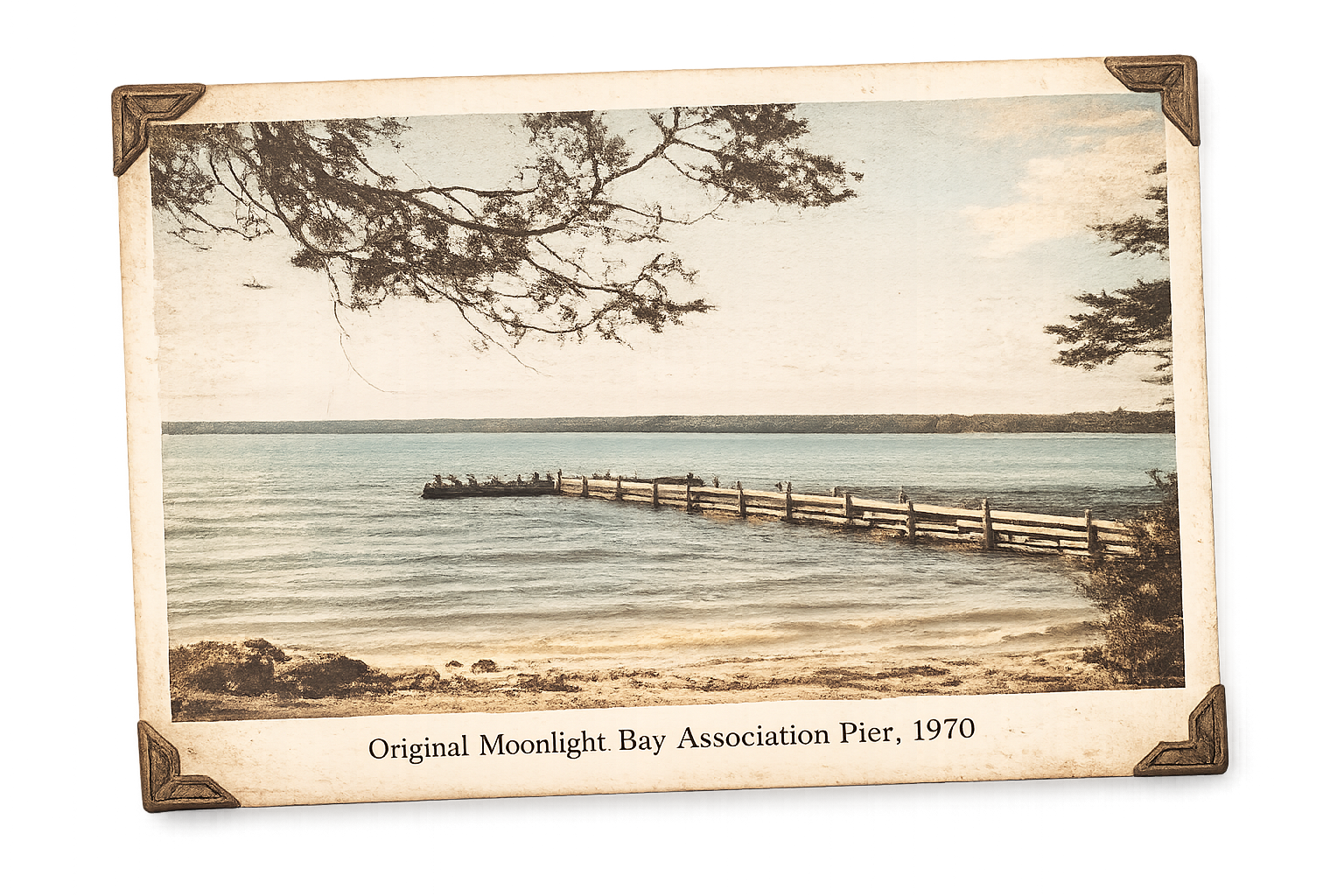
Back in the day, some residents kept their boats at the pier, and the larger boats had moorings, which can be seen to this day when the water level is low. John VanDenWymelenberg had a pontoon boat named “The Martini Boat.”
The official cocktail hour in Moonlight Bay Estates is 4:00—or earlier, as the situation may arise.
Dr. Lawrence Lanzl worked on the Manhattan Project, as did his wife, Elizabeth, but her involvement was in a different capacity. As of this writing, Elizabeth is still with us, the oldest of the old-guard members.
Animal Stories
The Infamous Moonlight Bay Bear
Sunflower seeds were a favorite, so he often satisfied himself at the neighborhood birdfeeders and made himself at home on people’s decks. The Scherpelz kids were surprised to wake up one morning and find him on their deck.
The Wisconsin Department of Natural Resources would take him to the Upper Peninsula, only to find him back again. During one of his banishments to the U.P., while in transit in Green Bay, he wore down his teeth by chewing on the bars of his cage.
Not being able to eat what he was supposed to in the wild, he was drawn back to the sunflower seeds in Moonlight Bay. It is believed that he remains to this day at Newport State Park—stuffed.
Karl and Shirley Raasch at one time lived in the home formerly owned by Rita Kramar. One morning, Karl was shaving in the mirror of the lower-level bathroom and called out to Shirley.
He was standing still, looking into the mirror, and said, “There is a buffalo looking in the window.”
She thought he might be suffering a stroke, but there it was: the reflection of a buffalo peering into the window.
There were two buffalo, actually. They simply turned and, after leaving hoofprints in the asphalt, made their way up the driveway to Old Logging Trail and eventually back toward home, where they lived on an old buffalo farm—then owned by a wealthy lady in California—off Cana Island Road.
In those days, the buffalo often escaped, especially the huge bull named Hercules. Hercules would ram the fence and was out and about too often. His final excursion took him to Cana Island Road, not far from the lighthouse.
Becoming a dangerous nuisance—he weighed approximately 2,000 pounds—he was exiled back to the farm, and it was said that “he impaled himself against a fence post.”
Bill Kelly fancied himself as a “naturalist” and self-appointed expert on all things native.
One weekend, when Barney Sielen was building his house, his wife discovered a four-foot-long snake in the attic of the unfinished house. Upon hearing her screams, Barney ran up to the attic and saw that it appeared to be a rattlesnake.
Being very late on a Sunday night and anxious to return to his home in Milwaukee, he called Bill Kelly to get his advice on removal. To his disappointment, Bill suggested making a noose of string and using a broomstick.
Not being the kind of advice Barney was looking for, and with it getting even later, he was forced to send the intruder to the promised land. It turned out to be a “pine snake” that God had blessed with a fake rattler and was not dangerous.
Over the years, we have shared the neighborhood with an assortment of critters:
Coyotes
Bears
Skunks
Rabbits
Wolves
Porcupines
Fishers
Woodchucks
Bobcats
Raccoons
Mink and ermine
Deer
Bats
Snakes
Cougars
Squirrels—red, gray, black and night-flying
Chipmunks
Owls of all kinds
Grouse
Turkeys
Birds, birds and more birdsTimes change, as do the seasons. With that, as their habitat disappears due to development, some species no longer thrive or exist here.
Stories told by others…
Moonlight Bay…its Name Was Mud - Peninsula Pulse, September 5, 2015
The Mysterious Abandonment of Moonlight Bay Village in Door County - Door County Historical Society Facebook page, 2001
The Mud Bay Ghost of Door County - The Pine Barrens Institute, August, 2020
John Brogan (original developer of Moonlight Bay Estates) Obituary